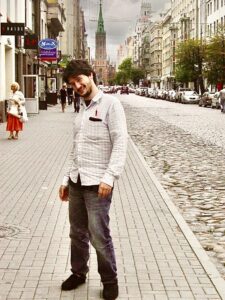
Jeremiah Runnels (Riga, 2008). Note the toothbrush and passport in the top pocket
I’ll start in 2006. You titled a quirky little piece I wrote for melodica quartet, “The Hague Invasion Act”. Your title referred to your country’s unwillingness to recognise the authority of the International Criminal Court (of The Hague, which was we were living).
After we played this piece, we read through many works Taylan Susam brought to the group: open-ended pieces by Christian Wolfe, and text scores by Mark So and Antoine Brueger. Playing through these pieces revealed your willingness to collaborate and simply TALK about music, or actually any other topic that came to your fast-acting mind. You could seemingly spin a discussion in 3000 directions, about almost anything and potentially forever. It was certainly an appeal of working together—one that made up for your lack of keyboard chops—because your dialogue was always interesting, especially when it landed on the topic of contemporary music. Here you’d become critical, intense, funny, religious, optimistic, passionate, convincing, and clearly committed to the notion that our small, individual or collective contributions (even if they sucked) were acts that defined us. And from this, composing or doing music was about resisting the many social pressures to conform; unless, as you would point out, you were so-and-so (I won’t name names here, but you would). In fact, writing this text makes me recall one of your many quips about being a composer: I believe you said, being a composer “is the best minimum wage job you can have.”
At one of our many weekly stadium generaale, we were asked by Marijke Reuvers if any of us composers would like to write a piece for twenty out-of-tune-pianos, I recall looking over at you in disbelief, and then simultaneously raising our hands. Was this a joke? Unbelievable. Far from being a joke, a few weeks later, eight of us composers were on the NS-train, taking a two-hour ride down to Eindhoven for our research expedition. This was about a month before the festival, so we could understand the condition of the 20 pianos and write our respective pieces. The donated pianos were all at the end of their life, they existed in various states of decay, mostly in terminal condition or beyond cost-effective repair. For my purposes, Teodora’s perfect pitch was a godsend; I took notes on how much each had fallen, and eventually treated the instruments as transposed estimates. You, however, were more in awe at the sheer spectacle, astonished by the dusty and time-worn collection, a work of art by themselves.
When we returned to Eindhoven, for the Editfestival, we drove down with Ingi—stopping briefly at IKEA to buy 20 electric milk stirrers, both of us exchanged predictions on how he was going to implement them in his piece. We got back in the car and continued the drive to Eindhoven, and when we arrived you and I were delighted to see that a wing of the abandoned section of the old Philips Factory had been dedicated to showcasing the 20 pianos. Marijke welcomed us, and showed us where food, snacks, and a lot of complementary wine could be found. Inevitably, a very good party ensued. After far too much wine, you and Ofir got into a very protracted argument (not the last), and this one was specifically about Yedo (the saxophonist, improviser and composer). You were both arguing endlessly about the cultural currency of improvisation versus to the more established practice of composition. The complementary wine flowed (copiously), and so did the party which eventually wound itself down, but your seemingly endless debate with Ofir raged on. Suddenly it concluded with Hikari, who, after multiple hours of hearing the name, sheepishly asked, “ahh, who is Yedo?” We all laughed at his comment, as his confusion defused the noxious debate and concluded the party. We all, rather drunkenly, went to bed.
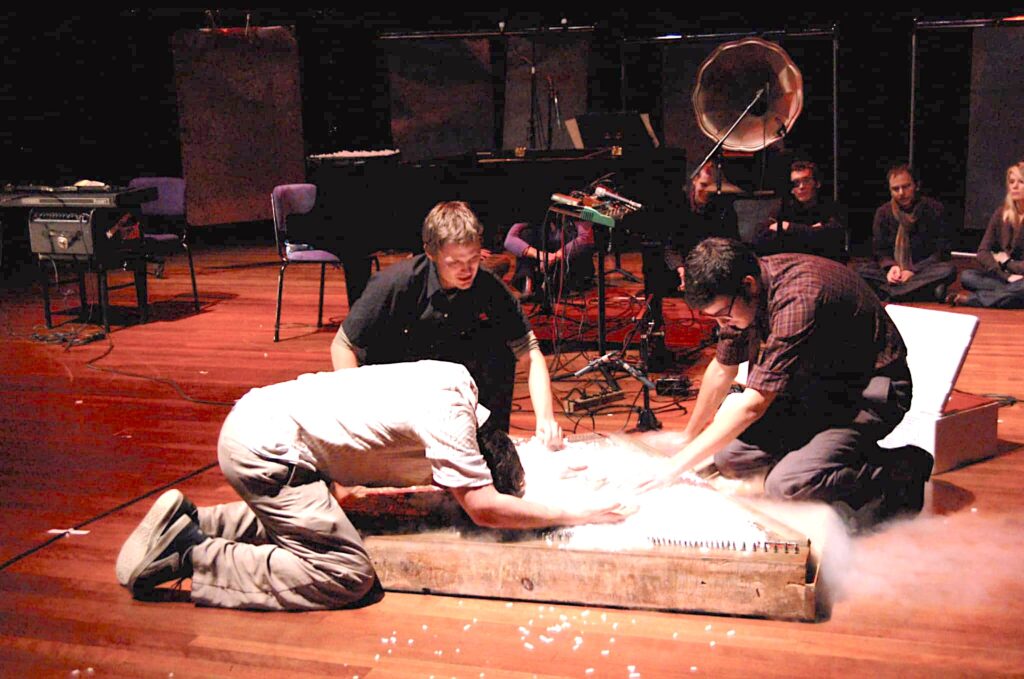
The day after you were so hungover you would hardly move from an oil stain you were resting in underneath the bleachers where the audience gathered. “It’s nice and cool here,” you explained, “I still need to sleep.” However, the next day after, I pleaded with you, “Come on, we have to record this performance”. Fortunately, you used your fairly capable audio-engineering knowledge and made the requisite X-Y with two good microphones, fortunately capturing all of those fleeting works. Buckshot was your piece’s title, and I’ll briefly break protocol here and mention that, in order to appease Gilius van Bergirijk’s penchant for fast music, you sped up the audio for your exam (it doesn’t matter now—both versions were cool). Your Buckshot, in my opinion, was pure Texas. I liked its authenticity and told you as much. Soon after our concert, the pianos were destroyed, we were sad, but the whole experience sparked ideas about what we referred to as Ghetto Spectralism—a musical experience inspired by spectralism but less informed by IRCAM software and more determined by what one could buy at a hardware store for 50 bucks. I also labelled your nonchalant and impromptu performance approach, where you would casually saunter onto stage as “Barbecue Style”. “Yes!” you exclaimed and laughed, “that’s it!”
You left soon after the Editfestival. You had planned to do live and study in Sweden the next year (in an attempt to salvage your marriage to Karin and to be with your daughter). We worked out an arrangement: I would sublet your “room” for a year for the absurd price of 38€ per month. Before you left, you showed me around the “atelier” on Schalk Burgerstraat. The room had peeling Winnie the Pooh wallpaper, no heat, no carpet, but we agreed that I would pay you the slightly inflated price (I believe you pocketed a cool 12€ a month from our arrangement; all serious squatters were livid). Naturally, it was not a great place to live, but the living room was carpeted and cozy, and that’s where I first heard about Pieter.
“Ah man, Pieter is great,” you said. You highlighted his amazing-ness vis-à-vis pointing to a mounted Pringle’s can he had jerry-rigged to acquire free internet. Astonishingly, it worked by way of science—magically harnessing ambient internet signals through the humble can. You explained that the exact dimensions of a Pringle’s can meant it acted as perfect amplifier of ambient WIFI single—here’s it important to recall that this was 2007, and “linksys” was still a common unsecured network.